Build stronger search visibility with an SEO strategy focused on technical foundations, useful content, local discovery and the changing way people search through traditional and AI-powered experiences.

Search visibility depends on much more than adding keywords to a page.
Technical barriers, weak search intent alignment, poor site structure and limited authority can make it harder for search engines and potential customers to discover the right pages.
A page may target keywords without answering what users actually want.
Important pages may be difficult for search engines to discover or understand.
Pages that should appear in search may not be indexed correctly.
Poorly connected pages can make site structure difficult to understand.
Pages may not provide enough useful information to compete effectively.
Businesses may struggle to appear when nearby customers search.
A website may have limited signals demonstrating relevance and trust.
Content may not be structured clearly enough for emerging AI-based discovery.
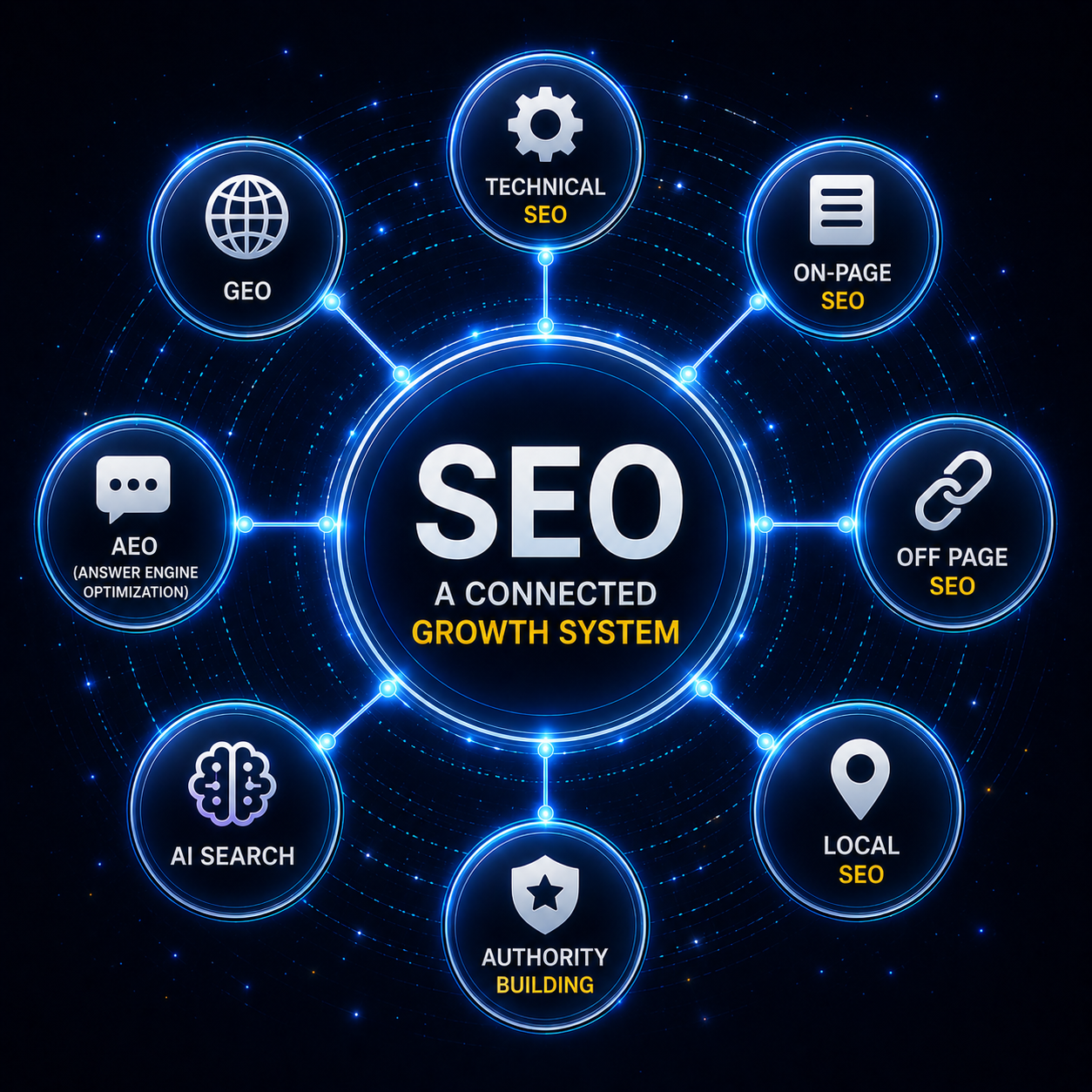
Strong organic visibility rarely comes from one isolated SEO activity.
Technical SEO helps search engines access the website. On-page SEO improves relevance. Off-page SEO and authority development strengthen external signals. Local SEO supports nearby discovery while AEO, GEO and AI-search optimisation prepare content for new search experiences.
SEO should not begin with a random checklist.
RankPrimora starts by understanding the website, business model, target audience, existing visibility and competitive environment before defining priorities.
Priorities forming
Technical SEO creates the foundation search engines need to discover and interpret a website efficiently.
The objective is to remove unnecessary barriers while creating a cleaner site structure for both users and search engines.
Help search engines discover important pages efficiently.
Identify issues that may prevent relevant pages from appearing in search.
Organise pages into a logical and understandable hierarchy.
Connect related pages and distribute relevance across the website.
Keep important content usable across devices.
Identify technical factors that may affect usability and search performance.
On-page SEO helps search engines and users understand what a page is about and why it may be useful.
Optimisation should improve clarity rather than make pages sound artificially written for search engines.
Keyword research becomes valuable when it helps determine what content should exist, which page should target a topic and what a visitor expects after clicking.
A useful content strategy connects search demand with business relevance.
Identify relevant commercial, informational and long-tail search opportunities.
Analyse the intent behind those searches.
Assign important topics to the correct pages and avoid unnecessary overlap.
Create useful content designed to answer the search properly.
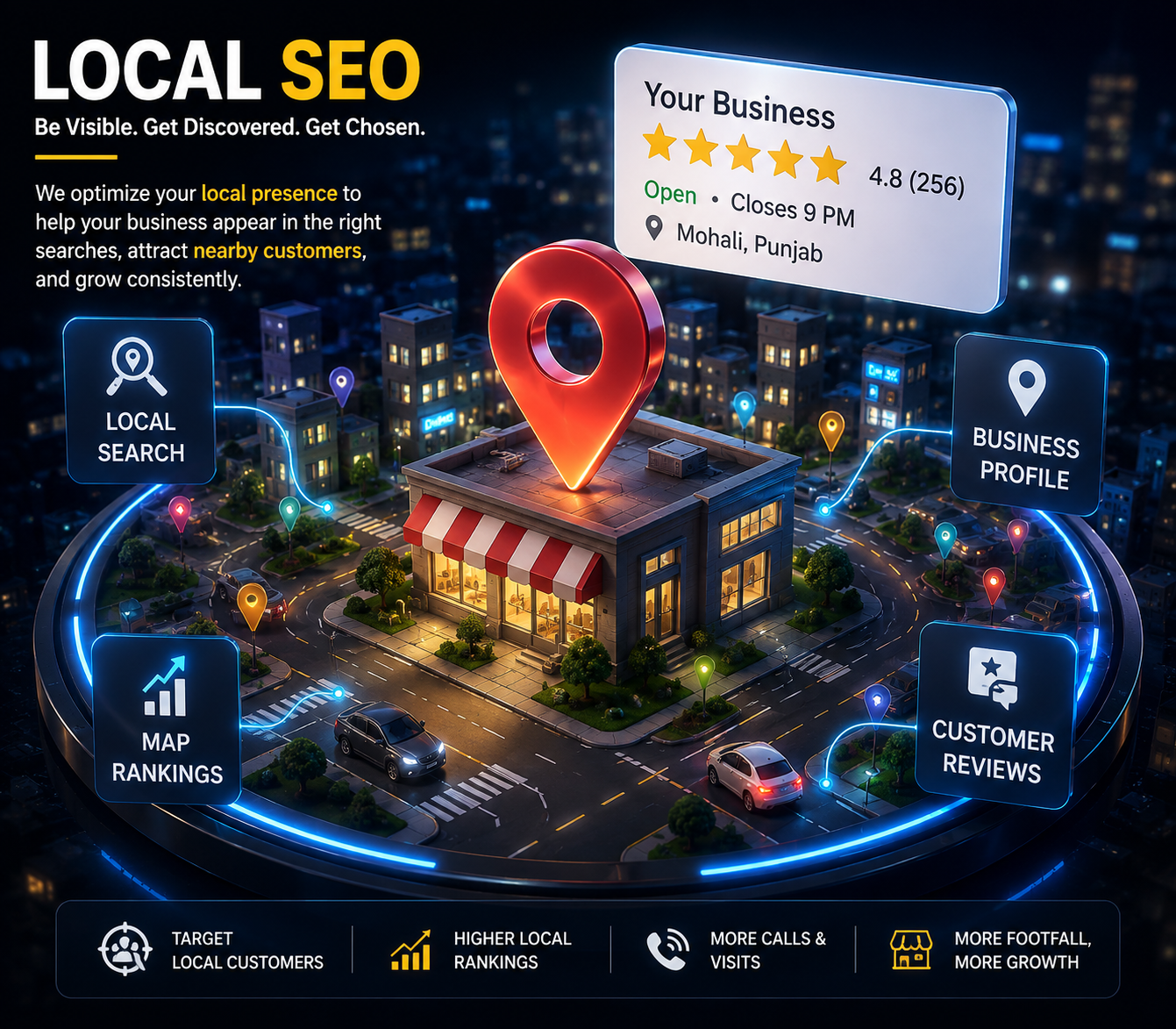
For businesses serving Mohali and nearby areas, local visibility can be just as important as traditional organic rankings.
Our local SEO approach focuses on helping search engines understand where the business operates, what it offers and why it may be relevant to nearby customers.
Search behaviour is changing.
People can now discover information through traditional search results, AI-generated answers, conversational interfaces and answer engines.
SEO therefore needs to consider not only rankings but also how clearly a business and its information can be understood across emerging search experiences.

Continue building strong organic foundations.
Structure useful answers that are easy to understand and retrieve.
Improve the clarity and context of information for generative search experiences.
Strengthen content structure, entity clarity and authority signals that may support discovery in AI-driven search.
Identify technical, content and visibility issues before optimisation begins. Every engagement starts here — the audit decides what actually gets worked on first.
Where it startsCreate a prioritised roadmap based on the website and business objectives.
Improve crawlability, indexing and website structure.
Strengthen page relevance, hierarchy and search intent alignment.
Identify useful search opportunities and map them to the right pages.
Improve existing content and identify useful content gaps.
Strengthen local discovery and business relevance.
Develop appropriate external authority signals.
Build stronger relationships between relevant pages.
Structure useful answers for answer-oriented discovery.
Prepare information architecture for generative search experiences.
Improve clarity, structure and discoverability across evolving search platforms.
Understand search visibility and user behaviour.
Communicate what changed and what should happen next.
Understand the problem before recommending the solution.
A keyword matters only when the page satisfies what the visitor actually wants.
Growth becomes harder when the website itself has unresolved structural issues.
Optimise for discoverability without sacrificing clarity or usefulness.
Consider traditional SEO alongside changing search behaviour.
SEO outcomes depend on competition, website condition, authority, content and execution.
Understand the business, audience, services and website objectives.
Review technical health, content, search visibility and local presence.
Prioritise opportunities based on relevance and potential business value.
Improve technical foundations, pages, content and local search signals.
Expand useful search coverage and strengthen authority.
Review performance and continually adjust priorities.
SEO scope varies depending on the website, competition and selected engagement. What follows is the working set — the exact list is agreed before anything starts.
SEO reporting should help a business understand progress rather than overwhelm it with dashboards.
Reporting focuses on meaningful search signals and the work being completed.
SEO does not produce identical results for every website.
The speed and scale of progress can depend on competition, website condition, existing authority, content quality, industry and the scope of optimisation.
Research, audit and technical priorities.
Improve important pages, content and local search foundations.
Expand relevant search coverage and strengthen authority.
Measure performance and refine priorities over time.
No shortcuts. No promises we cannot keep. Just the work that makes a website easier to find and easier to understand.
Recommendations begin with understanding the actual website. No template audit, no borrowed checklist — the starting point is your site, your market and what is measurably holding visibility back.
Diagnosis firstPriorities are selected based on relevance rather than unnecessary activity.
Understand what is being worked on and why.
Technical, content, local and authority work are treated as connected parts of one system rather than separate line items.
Search strategy considers traditional discovery and emerging AI experiences.
No fake ranking guarantees or misleading growth promises.
Work compounds — foundations first, then coverage, then authority.
SEO services help improve how effectively a website can be discovered and understood through search engines. The work can involve technical SEO, content optimisation, local SEO, authority development and performance analysis.
There is no universal timeline. Progress depends on factors such as competition, website condition, existing authority and the amount of optimisation required.
No. Search rankings cannot responsibly be guaranteed because search engines determine results using many factors outside an agency’s direct control.
An audit can review technical issues, indexing, site structure, on-page optimisation, content gaps, keyword opportunities, internal linking and local visibility depending on project scope.
Yes. Local SEO can include Google Business Profile optimisation, local relevance, citations, reviews guidance and local landing-page improvements where appropriate.
Technical SEO focuses on areas such as crawlability, indexing, site structure, internal linking, mobile usability and technical accessibility.
Answer Engine Optimisation focuses on presenting useful information in a clear structure that can support answer-oriented search experiences.
Generative Engine Optimisation refers to improving content clarity, structure and context for discovery through generative search experiences.
AI-search readiness can be considered through clear entity information, structured content, helpful answers, technical accessibility and authority signals.
Yes. Starting with a strong structure and search strategy can help avoid many problems that become harder to correct later.
Performance may be evaluated using visibility, search impressions, clicks, landing-page performance, keyword movement, local visibility and technical health.
Mohali is the primary local focus while RankPrimora can also work with businesses across India and selected international markets.
Possibly. The need for new content depends on existing pages, search intent, content gaps and the topics relevant to the business.
Start with a discussion about your website, current search presence and the areas where you want stronger visibility.
Let’s look at your website, current search presence and the opportunities that may deserve attention first.